
Do you remember last summer? I mean really remember it. The heatwaves that seemed to stretch on forever. The moment when you finally caved and turned on the air conditioner, knowing full well that your utility bill was about to explode. That sinking feeling when the bill arrived, and you saw that number, often double or even triple what you pay in the milder months.
If that sounds familiar, you are not alone. I have sat across the kitchen table from so many California homeowners who describe the exact same experience. They want to be comfortable in their own homes. They want to keep their families cool during those brutal summer days.
But they are tired of being held hostage by PG&E cooling costs that seem to climb higher every year. Here is the truth that changed everything for the families I work with. Your air conditioner does not have to be your enemy.
In fact, when paired with the right technology, it can become one of your greatest allies in the fight against high energy bills. The secret is pairing solar with a high efficiency cooling system. When you combine a solar AC system with a modern energy efficient AC, you are not just reducing your bill. You are cutting it in half, sometimes more. Let me show you how.
Why Your Air Conditioner Is Eating Your Wallet Alive: Understanding PG&E Cooling Costs
To understand how to fix the problem, we first have to understand what is causing it. Your air conditioner is the single biggest energy user in most California homes during the summer months. And here is the cruel irony. The hotter it gets outside, the harder your AC has to work.
The harder it works; the more electricity it pulls from the grid. And because utility companies charge higher rates during peak demand hours, which are typically the hottest parts of the day, you are paying a premium for that cooling.
PG&E cooling costs have been rising steadily for years. The summer heat drives up demand, and the utility passes those costs on to you. If you have an older air conditioner with a low SEER rating, the situation is even worse. SEER rating stands for Seasonal Energy Efficiency Ratio. The higher the number, the more efficient the unit.
An old AC with a SEER rating of 10 or 12 uses significantly more electricity to cool your home than a modern energy efficient AC with a SEER rating of 18, 20, or higher.
How a solar ac system takes the sting out of summer?
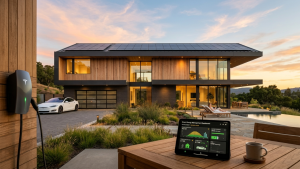
Imagine for a moment that your air conditioner runs almost entirely on free energy from the sun. Imagine that during the hottest part of the day, when your AC is working its hardest, your solar panels are producing the most power. That is the magic of a solar AC system.
Your solar production peaks at exactly the same time your cooling demand peaks. The sun is beating down on your roof, making your panels produce at maximum capacity, and that power is going directly into running your air conditioner.
When you have a solar AC system, you are no longer at the mercy of PG&E cooling costs. Instead of buying expensive electricity from the utility during peak hours, you are generating your own. The AC load offset, which is the percentage of your cooling energy that comes from solar, can be 80, 90, or even 100 percent on a sunny day. That is not a reduction in your bill. That is an elimination of your cooling costs for those hours.
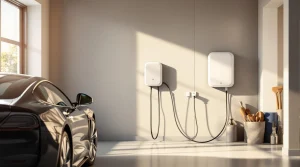
Now, what about the evenings when the sun goes down but the heat lingers? That is where solar powered cooling really shines. If you add a home battery storage system to your solar setup, you can store the excess energy your panels produce during the day and use it to run your AC at night.
Your cooling is powered by the sun, even after the sun has set. You are avoiding peak rates, you are using clean energy, and you are keeping your family comfortable without the guilt of a massive utility bill.
Energy Efficient Ac: Why Your HVAC Installation Should Prioritize Seer Rating
Pairing solar with an old, inefficient air conditioner is like putting premium fuel in a car with a sputtering engine. It helps, but you are not getting the full benefit. To truly cut your bill in half, you need to pair your solar with a modern energy efficient AC. This is where HVAC installation becomes a critical part of your energy strategy.
When you invest in a new energy efficient AC, you are looking for a unit with a high SEER rating. The federal minimum is around 14 or 15, but the most efficient units on the market today have SEER rating s of 20, 22, or even higher. What does that mean in real terms?
A high SEER rating means your air conditioner uses significantly less electricity to produce the same amount of cooling. A 20 SEER unit uses about half the electricity of a 10 SEER unit from 20 years ago.
Now combine that high SEER rating with a solar AC system. You have dramatically reduced the amount of electricity needed to cool your home, and you are generating that electricity for free from your roof. The result is a cooling bill that is a fraction of what it used to be.
What to expect from our HVAC service?
I know that talking about SEER rating, AC load offset, and the differences between heat pump vs central air can start to feel technical. That is okay. You do not need to become an expert in all of this. That is what our HVAC service is for.
When you work with us, we do not just install solar panels and walk away. We look at your whole home. We look at your existing air conditioner, its age, its SEER rating, and how much energy it consumes. We talk to you about your comfort, your budget, and your goals.
Then we help you design a system that combines solar powered cooling with a high efficiency HVAC installation that fits your home and your lifestyle. We handle everything from the HVAC installation to the solar design to the permitting and interconnection with the utility.
You get one team, one point of contact, and one seamless experience. And you get a home that is cooler in the summer, warmer in the winter, and dramatically cheaper to run year round.